Showing posts with label VFD. Show all posts

Friday, October 26, 2012

The Electronic Quick Change Gear Box, part 5

(continued from part 4)

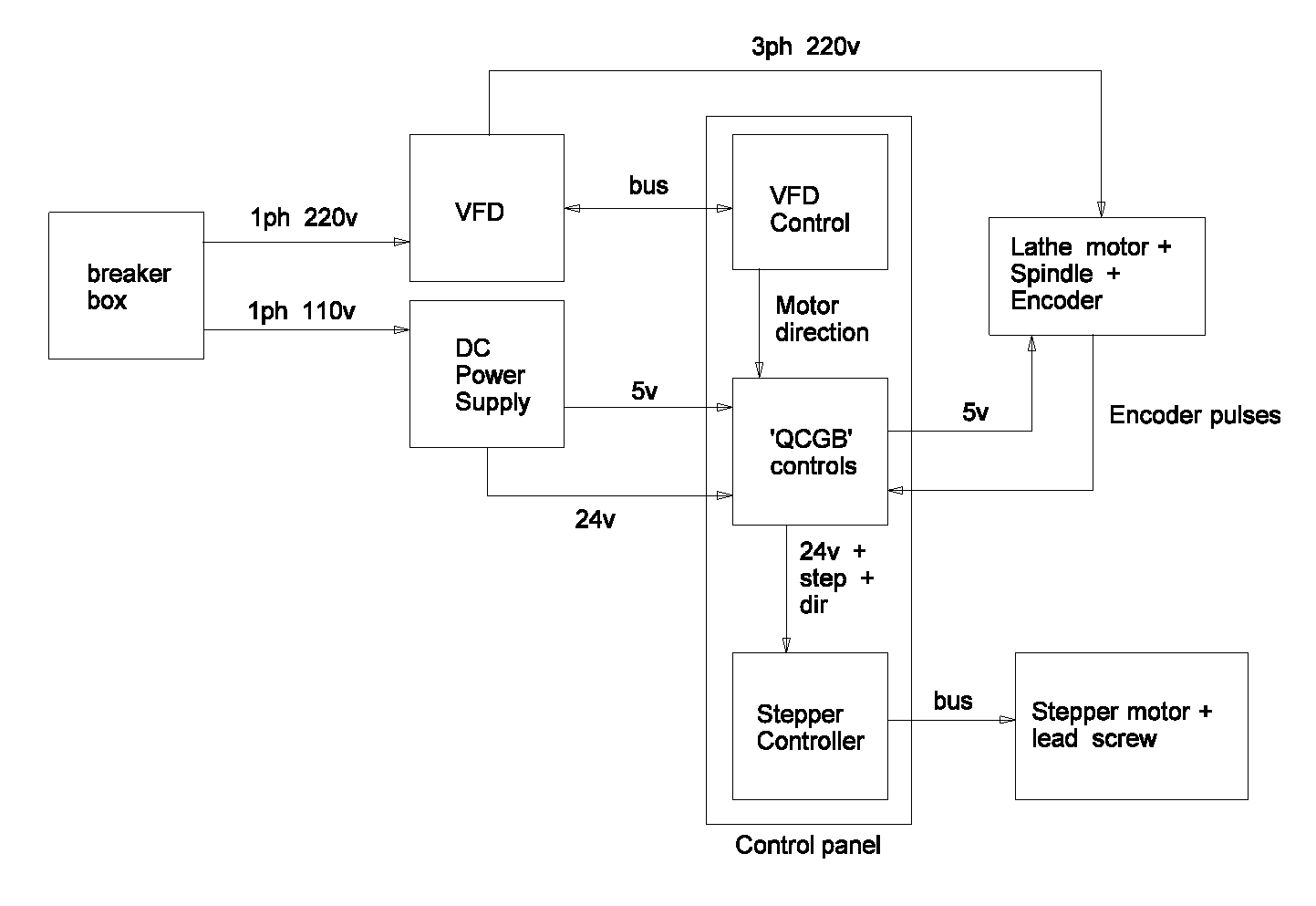
The block diagram from the previous entry may be informative but there's something to be said for seeing the actual components.

You can see the breaker box and VFD here, if you wish.  The breaker box is bog-standard. The VFD lives below in its own enclosure.  The control pendant (VFD Control in the block diagram) is sitting on the VFD enclosure. It has 2 toggles and a rotary knob.  One toggle powers the motor, another makes it run forward or reverse, and the knob sets motor's speed.  It's pretty sweet.  I'll be combining these controls with the new control panel.

Here's the power supply that will power the electronics and stepper motor:


It's somewhat over-sized being about 18" long.  It was salvaged from an industrial photocopier. This is great since it was made to power electronics and steppers.  It has 3.3v, 5v, and 24v outputs. It's basically perfect.  I am confident it will produce superb power and last for a long time.  And the price was right!

Here's the encoder. It came from U.S. Digital. It fills the palm of my hand.  The encoder consists of a case, a sensor fixed to the inside of the case, digital output pins, and disk that spins within the case.  The disk has 1024 marks on it.  As it spins, the marks pass through the sensor to produce pulses that are made available by the pins on the far right.  As an extra bonus, this particular encoder supports quadrature output which quadruples the number of pulses.  Thus this encoder produces 4096 pulses per revolution.  The lathe has a gear train connected to the spindle.  I'll mount the encoder to the head stock, fit a shaft to the hole in the encoder's disk, and spin the shaft from the gear train.


Here's the actual CPLD board I'll use for this project.  The image from part 1 of this series is a feature-rich development/learning board.  This board costs about 1/3 as much.  It measures just over 1" x 2".  It's a product of Dangerous Prototypes and sold by their partner seeedstudio.


Since I have not yet selected the stepper motor, I can't say for sure what stepper controller board I'll buy.  Candidates are the Big Easy Driver from Sparkfun and Polulu's A4988 Stepper Motor Driver Carrier with Voltage Regulators.

The stepper will be standard. Right now I'm debating on the NEMA 23 or 34 frame size.  I'm leaning towards a bipolar model with a 23 frame and 1.8 degree steps.  The torque is really the question now.

Sunday, October 21, 2012

The Electronic Quick Change Gear Box, part 4

(continued from part 3)

Continuing on, it will be helpful at this time to identify the physical components of the lathe and QCGB components.  It always surprises me how many parts there are when I take a step back.

Working roughly from left to right, we have:

1. The breaker box.  This is typical and has 220v 1ph power running to it.  Here's a picture including the VFD.  It will supply 220v power to the VFD and 110 to the DC Power Supply.

2. VFD. This is a remarkable device that converts garden-variety one-phase power into three-phase power. The VFD also affords a remarkable amount of control over many aspects the motor. Highly recommended.  The VFD is controlled by the 'VFD Control' component, which I'll get to soon.

3. DC Power Supply.  The stepper motor needs 24v at up to 2 amps.  The CPLD requires 5 volts and a few milliamps of power.  The DC power supply will produce both from wall current.

4. VFD Control:  These are remote controls for the VFD. They allow me turn on the motor, control the speed, and control the motor's direction or rotation.  The only commonality between these controls and the QCGB project is that I want to know the direction the motor is spinning.  This is crucial when cutting metric threads.

5. 'QCGB' controls:  These are the controls specifically dealing with the QCGB and the circuitry to support them.  You can see a diagram of what they may look like the previous installment of this blog.  The controls include some indicator LEDs and a switch that energizes the CPLD and the stepper controller.  What's important here is that the 24v stepper power be isolated from the 5v general electronics circuitry.  This will likely be done with a relay.  The CPLD that's under the hood is is the heart of the project.  It collects the pulses from the spindle, performs the division, and sends the result to the stepper controller.

6. Stepper controller:  This is a circuit that accepts a pulse and direction and moves the stepper motor appropriately. It does this by manipulating the motor's windings using the 24v 2a power supplied by the DC power supply.

7.Stepper Motor and lead screw: The stepper motor is a motor designed to rotate in discreet steps, with 200 steps/rev being common. They allow very fine control. As the stepper motor turns, it turns the lead screw and this pulls the carriage down the lathe and a very controlled speed.

8. Lathe motor, spindle, and encoder.  The motor spins the spindle which spins the encoder.  The encoder I'm using will produce 4096 pulses every time the spindle makes one complete revolution.  These pulses are fed into the CPLD chip which is configured to divide in such a way to send the proper number of pulses to the stepper controller.

The VFD Control, 'QCGB' controls, Stepper Controller, and related controls will be housed in a metal case and be presented to the user by a control panel.

The VFD is already housed in the breaker box.

Part 5 is Right This Way...

Thursday, April 29, 2010

Power and a new toolpost for the Lathe

I have been slowly restoring an abused Atlas/Craftsman 12" lathe to service. I've posted about the trials and tribulations over the last few years.

Recently I had an electrician install a new sub-panel for my basement shop. The electrician wired in a VFD, an amazing device that converts single phase power to 3-phase power. It lets me control almost anything related to the motor. For example, I configured the VFD so it starts the motor smoothly and will spin up to full speed in about 5 seconds. However, I configured it to stop the motor in 2 seconds. The VFD allows variable speed control without a loss of torque [1/27/13 - probably need a fact-check on this.] It also lets me reverse the motor. Good stuff. Further, the VFD supports a remote control panel so I can control the motor from the front of the lathe and not have to reach my hands in the sub-panel.

Here's the electrical work. The subpanel has breakers for outlets and the VFD. The white device is the VFD. It's about 4" x 4" x 6" and weighs nothing. The control pendant is sitting on the VFD's box. It has a potentiometer for the motor RPMs, an on/off toggle, and a forward/reverse toggle. Underneath the VFD's box, partially seen, is the 3-phase outlet for the motor.


Another advantage of 3-phase motors is that normal people don't want them. The nice Rockwell 1/2hp motor on my lathe was a Craigslist freebie. Gotta love that!

Here's the motor in all it's link-belt glory.


Moving on, the lathe's olde-school (circa 1936) lantern tool post has been "modified" and doesn't function properly. While it's fixable, I only have 2 of the special holders this tool post needs and they're expensive. So I replaced it entirely with a modern quick change tool post. It's a lovely thing. A quick change tool post set includes one toolpost and numerous holders. Cutting bits are secured in holders by Allen screws. The holders slide onto dovetails milled into the tool post and are locked in place when a lever is turned. It takes about 3 seconds to put a new tool in the tool post. Here's a picture of the new toolpost and an inaugural 5-foot long shaving.